Skip to content
Farm Market News
Crew at Corteva’s Jackson seed plant has much to celebrate in 2026
Fmn lead seed feature 3788
Facility turns 45,
Pioneer brand marks a century

The crew at Corteva Agriscience’s Jackson Seed Production Facility has a lot to celebrate in 2026.
Plant staff will not only celebrate 45 years of operation in Jackson’s industrial park, but also mark 100 years of Pioneer seed, the global flagship brand of Corteva Agriscience.

Both the Jackson plant and the Pioneer seed brand have humble roots.

The Jackson plant began with seven employees processing seed beans grown on 10,000 acres in eastern Jackson County back in 1981. Today, it is a key part of Corteva’s extensive seed and crop protection network.

The Pioneer seed brand began on a small farm owned by Henry and Ilo Wallace in Johnson, Iowa, back in 1926. Founded as Hi-Bred Corn Co. — and later dubbed “Pioneer Hi-Bred Corn Co.” — the business was the first in the world develop, grow and sell hybrid seed corn. By the 1930s, Pioneer had expanded sales across the United States, becoming a leading supplier of hybrid seed corn.

The company began international sales, research and seed production in the 1950s and ’60s, then changed its name to Pioneer Hi-Bred International and established a separate overseas subsidiary in 1970. DuPont purchased 20 percent of Pioneer Hi-Bred International in 1997, then the remaining shares in 1999. In 2018, DuPont Pioneer became part of the Agriculture Division of DowDuPont, then part of standalone agriculture company Corteva Agriscience in 2019.

Caroline Ahn, global media relations representative for Corteva, said Pioneer has pioneered a number of innovations over the years. It launched the first million-unit corn product in 1947, the first insect-protected corn in 2010, the first drought-tolerance native trait in corn in 2011 and the first biotech high oleic oil soybeans in 2012. She said Pioneer brand Z-Series soybean variety P49Z02E is the world’s top-yielding soybean variety, Pioneer P14830VYHR is the world’s top-yielding corn hybrid and Pioneer brand 86G42 is the world’s top-yielding dryland sorghum variety.

Today, Pioneer brand seed is sold is around 70 countries across the globe and is the top corn and soybean brand in the United States.
Boverhofs grow and sell a variety of produce
Boverhofs
Kyle Kuphal | Staff reporter
kkuphal@pipestonestar.com

Gary and Marsha Boverhof grow a variety of produce at their farm west of Edgerton that they sell around the area under the name Boverhof Produce.

Gary is a Michigan native and Marsha is originally from Iowa. Gary started growing produce in Michigan when he was in grade school and continued to work for a vegetable farmer there after high school. He brought those skills with when he moved to the Edgerton area in 2002.

Since then, the Boverhofs have sold their produce at farmers markets, wholesale, at grocery stores and from their yard. Gary said they now sell primarily at farmers markets, including Rock Rapids, Luverne, Edgerton, Pipestone, Marshall and others.

“We’ve enjoyed the farmers markets and getting to know our customers,” Gary said.

The Boverhofs grow sweet corn, peppers, cabbage, tomatoes, green beans, squash, zucchini, cucumbers, kohlrabi and eggplant. They grow their produce on about 25 tillable acres and in four greenhouses. This spring, they plan to add two more greenhouses that came from the producer Gary used to work for in Michigan. Gary said there’s no heat in their greenhouses and they plant directly into the ground, using drip tape to water.

Marsha said all of their tomatoes are grown inside the greenhouses.

“The huge benefit for us is that it’s protected from the wind and protected from the rain,” Gary said. “That’s where all the disease comes from in tomatoes, it’s from that rain splashing up the soil. The disease, like blight, will store in the soil, and then when that rain hits the soil it splashes up on the leaves and then it spreads.”

They also grow some cucumbers and peppers in the greenhouses and start some other plants in them, so they’re ready earlier than if they were started outside. Gary said the family starts all their crops from seed.

In addition to the crops, the family has about 75 chickens from which they sell the eggs. Gary and Marsha said their children primarily take care of the chickens.

Marsha also has a cottage food license and the family makes and sells baked goods at the farmers markets. Their offerings include bread, pies, rolls, cookies, bars, jams and salsas.

The Boverhofs have five children, the ages 10 to 20, who help on the farm. Gary said one of the aspects he most enjoys about working in the business is working with his family.

“It’s a lot of fun,” he said. “It’s rewarding to be able to work together.”

In addition to family members, Gary said they have some kids from the area come out and help on the farm. He said it’s a win-win situation with the kids learning some work ethic and earning some money.
This is the slow season at the farm when they work on equipment and get ready for spring. They start seeding in a warmed starter house on March 1.

Gary said they typically transplant into their other non-heated greenhouses in mid-April.

Off the farm, Gary drives bus for Southwest Minnesota Christian school and Marsha works in the kitchen at the school as needed during the winter. The Boverhofs are part of the Minnesota Grown and the Minnesota Farmers Market Association.
Producers donate soy-based firefighting
foam to area departments 
Fmn lead alt ag feature 0002
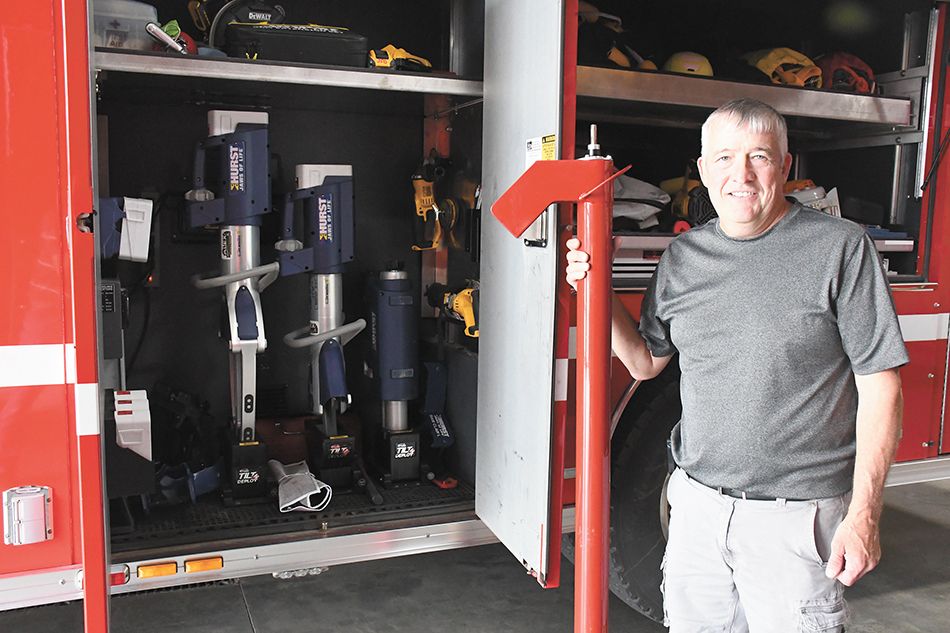
Fire departments across south-central Minnesota have a new extremely effective — and environmentally-friendly — tool in their toolboxes thanks to local and area soybean producers.
Producer groups from Jackson County, Martin County and Nobles County recently donated pails of SoyFoam to fire departments in their counties.
The Jackson County Corn and Soybean Growers donated SoyFoam to fire departments in Alpha, Heron Lake, Jackson, Lakefield and Okabena. The Martin County Corn and Soybean Growers donated SoyFoam to fire departments in Fairmont, Truman and Welcome. And the Nobles County Corn and Soybean Growers donated SoyFoam pails to fire departments in Adrian, Bigelow, Brewster, Ellsworth, Lismore, Round Lake, Rushmore, Wilmont and Worthington.

Made with soy flour, SoyFoam is the first and only Greenscreen Certified Gold fire foam with zero intentionally added per- and polyfluoroalkyl, or forever, chemicals.

“We are proud to be able to donate the SoyFoam product to the fire departments in our community,” said Albert Henning, treasurer of the Jackson County Corn and Soybean Growers Board of Directors. “The departments were very appreciative of the product not only because of the safety of the product for the environment, but for the health of the firefighters as well. These donations help support our local firefighters with safer, more effective tools and promote a new use for soybeans.”

Jacob Sukalski, treasurer of the Martin County Corn and Soybean Growers Board of Directors, agreed.
“The departments were happy to receive the donation and excited to give it a try since it would work with their equipment,” Sukalski said.
Matt Widboom, chair of the Nobles County Corn and Soybean Growers, said his group was happy to be able to give back to local firefighters.

“This is a wonderful contribution to our county fire departments,” Widboom said, “and we appreciate these volunteers that keep our communities safe.”
The donations were made possible by the farmer-led Minnesota Soybean Research and Promotion Council, which last spring launched the soy checkoff-supported SoyFoam campaign, “Planting to Protect: From Farm to Flame,” in conjunction with Cross Plains Solutions, the developer of Soy-Foam, which has partnered with the soy checkoff to continue testing and promoting the product as a safer alternative to traditional firefighting foam. Through the campaign, the council is offering more than 40 organized soybean counties in Minnesota the opportunity to donate SoyFoam to area fire departments.

“For our soybean farmers, your checkoff investment is helping out the environment and the firefighters who use it,” said council director and past chair Tom Frisch, who has served on the Dumont Fire Department since 2000. “It’s a checkoff investment that is coming to fruition and helping build demand. For our firefighters — rural, city or anywhere in Minnesota — providing a PFAS-free alternative is our goal. For the public in general, homegrown, renewable products benefit all of us.”
SoyFoam is compatible with existing foam inductors and aerating nozzles and is comparable in cost to traditional firefighting foam. With a shelf life of 10 years, SoyFoam can be frozen, heated and thawed and will still be fully functional. It’s also projected to increase demand by using protein from 12 million bushels of U.S. soy.

The Jackson County Corn and Soybean Growers, Martin County Corn and Soybean Growers and Nobles County Corn and Soybean Growers are affiliated with the Minnesota Soybean Research and Promotion Council, a 15-person, farmer-led board that oversees the investment of checkoff dollars on behalf of the state’s nearly 26,000 soybean farmers. The council is governed by the rules of a federally mandated checkoff program requiring all soybean producers to pay a fee on the soybeans they sell. This money is used to promote, educate and develop market opportunities for soybeans.
New technology can help target weeds, cut costs and increase yields
Web device
Kyle Kuphal | Staff reporter
kkuphal@pipestonestar.com

New technology that targets weeds is getting positive reviews from those who have used it in southwest Minnesota.

One of the items is John Deere’s See & Spray system. The other is the SMARTSCRIPT drone system from Sentera, which was acquired by John Deere earlier this year.

Ross Van Hulzen, of Edgerton, said Van Hulzen Farms has a John Deere 412 R sprayer that was equipped with See & Spray and another one that came with the technology factory installed that they started using this year. The technology uses cameras mounted on the boom of a sprayer that “look forward and see the weed before the nozzles pass over them,” Van Hulzen said. He said the driver can travel up to 12 mph while using the system, which makes split second decisions about whether to spray or not.

Van Hulzen said the cost saving potential was the biggest factor that interested him in trying the See & Spray technology. The fact that crops that don’t need to be sprayed aren’t sprayed was another factor.

Nick Einck, director of agronomy, at Chandler Co-op, said the Co-op started using the See & Spray and the drone technology this year. The drone uses high precision technology to detect, identify and map weeds with accuracy, according to Sentera. That information is uploaded to Sentera, which provides a prescription that’s uploaded to sprayers, which can then identify exactly where a weed is and which nozzle needs to turn on at what time to spray it.

Einck said Chandler Co-op was interested in the technology in order to implement what it refers to as “site specific spraying.”

“What that means is we’re using technology to identify exactly where the weeds are and just spray the weed rather than the acre,” Einck said. “What that allows for us is an opportunity to cut chemical costs and hopefully boost yields because we’re not taxing the crop with metabolizing all that chemistry.”

To use the See & Spray equipment, the operator selects the crop that’s in the field and anything that’s not that crop gets sprayed.

“It’s approved for corn and soybeans,” Van Hulzen said. “If you have it set that you’re spraying corn, it knows what a corn plant looks like, so anything that is not corn that it identifies as vegetation, it considers that a weed. When you’re in beans, corn is actually a weed in beans, so when you’re spraying beans it actually sprays corn.”

If no weeds are detected, no spray is applied. Van Hulzen said that’s the case the majority of the time.
“In corn, we did not apply 63 percent of the time and we did apply 37 percent of the time, so there was a 63 percent savings in chemical,” Van Hulzen said. In beans, they saved 57 percent.

He said the amount of savings varies from field to field based in part on the amount of weed pressure. It also depends in part on the chemical program used by the farmer.

John Deere charges a per acre fee for the See & Spray system when it’s turned on and not applying herbicide. There is no charge for when chemical is applied. Van Hulzen said that even with the fee, the system is worthwhile.

“The savings outweigh the fee just because there are so many acres you don’t apply,” he said.
Van Hulzen said the technology also saves time because the operator doesn’t have to stop and fill up the tanks on the sprayer as often, and it’s easy to use.

“If you’ve run a John Deere sprayer, it’s very easy to run,” he said. “Literally, you turn it on or you turn it off, and by toggling it on, you just tell it what crop you’re in and it really takes care of itself.”
Einck said the drone must be flown by a trained and certified individual.

He said both the drone and the See & Spray technology have similar outcomes and he’s found them to be equally effective. He said they allow Chandler Co-op to help farmers save money on chemical, and those dollars can then be reallocated to other measures that can help increase yields.
Einck said the technology is expensive for individual farmers, which is why it makes sense for a retail outlet such as Chandler Co-op to purchase it and make the technology available to them. While this type of technology is used by a limited number of farmers today because they’re new, Van Hulzen and Einck said they expect it will catch on and become more widely used. They also expect it to grow in its capabilities and be able to provide additional data in the future.

“We’re sure excited to see where the future takes us and we’re excited that we can offer this for our farmers, our customers and our owners, being as we’re a co-op,” Einck said.
Jackson-built tractor shines as it makes its
way across country
Golden fendt 0001
A tractor of a different color recently rolled off the manufacturing line at AGCO Jackson Operations — and headed straight out on a high-profile national tour.

Among the stops for the one-of-a-kind golden Fendt tractor were the U.S. Capitol back in August in commemoration of the Great American Farmers Market, the Farm Progress Show in Illinois later that month and the National FFA Convention and Expo in Indianapolis, Ind., earlier this fall.

Built in Jackson, the machine features a full gold exterior, a patriotic window wrap and a farmer-first message: “We Support American Farmers.”

Typically clad in Fendt green, the shiny golden Fendt 1167 Vario MT track tractor is the company’s way of saluting U.S. growers, said Mike Long, vice president of Fendt North America.

“Fendt is proud to stand with American farmers,” Long said. “This golden tractor is a tribute to their resilience, innovation and the vital role they play in helping feed the world.”

U.S. Secretary of Agriculture Brooke Rollins was the first person to sign the tractor earlier this year at the Commodity Classic in Denver. Several dignitaries added their signatures in Washington, D.C., in August.

Following its national tour, the golden tractor will make its permanent home at the Fendt Lodge in Jackson.
As harvest ends, planning begins
Web jon
Kyle Kuphal | Staff reporter
kkuphal@pipestonestar.com

The 2025 harvest is winding down and it’s time to plan for next year’s crop.

Jon Risacher, a crop consultant with Nutrien Ag Solutions in Pipestone, helps farmers do just that. The goal, he said, is to maximize the number of bushels through management practices. That includes looking at fertility, seed, plant health, disease, insects, what worked and what didn’t, and more. He said it all comes down to management.
“You’ve got to be a good manager to be successful,” Risacher said.

Risacher, who also grows corn, soybeans, alfalfa and oats, said planning for the next year starts during the harvest when farmers are out in their fields looking at factors such as weed pressure. He said weeds were a challenge this year, specifically water hemp.

“The weeds take your fertility,” Risacher said. “They take your moisture, they rob from your crop, so if you don’t get them under control you’re going to give up bushels, and it was kind of prevalent this year. In corn we saw some pretty big reductions and definitely in beans. It just choked the beans out.”

Risacher said there were also disease issues with corn this year. He said tar spot was expected to be more prominent, but it turned out that southern rust  was the bigger problem.

“I would say between the disease and water hemp, those are going to be our two biggest conversations this year,” Risacher said.

Pests were not as big of an issue this year. Risacher said there were pockets of aphids, but not as extreme as it’s been in other years, and root worms were not as much of a problem as they were a couple years ago. He recommended farmers to keep an eye out for them, however.

Choosing the right seed varieties and hybrids can help with some of these issues and is a major consideration when planning.

“Seed is always the most emotional because that’s the first thing you truly do,” Risacher said. “Yes, fertilizer, but there’s still fertility in the ground. Seed, you’ve got to get it into the ground and get it out of the ground, and you’ve got to wait six months before you know what you did right or wrong.”

For perspective, he said that in a lifetime a farmer might get just 40 chances to decide what seed to use.

Soil sampling is another practice farmers might implement to prepare for the next growing season. It can measure things like nitrogen, phosphorus, potassium, sulfur, zinc, boron and iron. Risacher said that’s typically done every four years or so.
He said marketing is also a factor, and plays a bigger role than it used to.

In general, farming is a risk and the goal is to manage the risk.

“Make a plan and adjust, would be my biggest preach to anybody,” Risacher said. “And don’t be afraid to adjust. You have to adapt because things can change.”

He also encouraged farmers to consider their budget when making management decisions and not to be afraid to ask questions.

“I would say work with somebody that you’re comfortable with and that you trust, and find the right questions that you want to ask,” Risacher said. “I personally write a lot of notes on little things. I write sticky notes everywhere.”
Pre-planners of the future
Fmn pre planning feature 0001
By Justin R. Lessman

A group of Jackson County Central FFA members are well-poised to be the agricultural pre-planners of the future.

Four members of the chapter’s farm management career-development team recently returned from a grueling national competition that took place in conjunction with the National FFA Convention and Expo in Louisville, Ky. The local team earned the right to compete in the prestigious contest by winning the state contest this past spring.

Retired JCC FFA Chapter advisor Jeff Voss and local ag producer Brad Milbrath are team coaches. They say the scope of knowledge team members are expected to master in order to compete at the highest levels is vast.

“It’s a very diverse set of knowledge these kids need to have,” Milbrath said.

It includes everything from balance sheets to benchmarking, income statements to income taxes, budgeting to types of business organizations, cashflow to insurance, price hedging to risk management, microeconomics to macroeconomics and more.

The state contest consisted of a two-hour test dealing with a specific scenario and a separate hour-long multiple-choice test, Voss said. The national competition was a bit different, consisting of a three-hour individual test and a one-hour team activity.

The slightly different competition format meant a slightly different approach to preparing for the national contest, Milbrath said.

“We’ve been practicing the group test portion quite a bit, while also continuing to brush up on the other general knowledge the students need to have,” he said.

Practice for the national competition began just a few weeks after the team won the state competition during last spring’s Minnesota State FFA Convention, though the team was forced to deal with a little hiccup right off the bat.

“Rachel Mohr, who was a senior at the time, was one of the members of the state-champion team, but due to some scheduling conflicts with college, we needed to find a replacement,” Milbrath said.
Enter Isabelle Henning, sister of team member Samantha Henning, who spent the last several months engaged in crash-course learning to get up to speed.

“If everybody has been working hard to prepare for the national contest, Izzy has worked extra hard to get where she needs to be to help this team compete,” Voss said.

That hard work that began this past spring continued all summer long and ramped up this fall.
“It takes a special kind of kid to want to come into school during the summer and learn about spreadsheets and micro- and macroeconomics,” Voss said. “These kids did that.”

With Samantha Henning also off to college this fall, the team had to pivot again, including her in weekly practices virtually.

“We’ve been practicing at least once per week, with Sam calling in,” Milbrath said. “We do what we have to do.”

“Some of these kids have jobs; some are helping with their family farming operation,” Voss said. “Brad farms; I work. It’s a balancing act.”

The team faced one final hurdle when Samantha Henning fell ill and had to be replaced by fellow chapter member Kylie Zishka at the last minute.
Despite the hiccups and hurdles, Voss said he is proud of the team and how hard team members worked to get ready to represent Minnesota at the national farm management contest.

“To do well, you have to prepare,” he said. “The team did that ahead of the state competition last spring and has done that again ahead of the national competition.”

Milbrath agreed.

“It’s a lot for these kids to know,” he said, “but they know it.”

Other team members include Rylee Benda and Landon Carter.